
Tuesday, January 09, 2007


Drepung Monastery... monks debating

From our vantage point up on the main courtyard you could see into the courtyard directly below us. Here monks were holding their afternoon debating sessions. Loud shouting and slapping of hands echoed throughout the whole area. They practice questioning each other over Buddhist concepts, histories and such. The person doing the responding stands and sort of rocks from foot to foot as he loudly speaks, emphasizing a thought or ending a dialogue by stamping his foot and slapping his hands together loudly in the direction of the person doing the questioning. We never had ANY clue what was actually being said, but their energy and emphatic facial expressions kept us mesmerized. This must have been a hot day in the debating courtyard, because hours after it was over we passed two monks standing in the middle of a pathway still goin at it! Hands slapping, feet stomping and all, just between the two of them. They had some things to suss out...


Drepung Monastery... ruins


Drepung was the largest monastery in the world at its peak, and it held alot of power politically because of this. So when the Chinese brought the Cultural Revolution down in Tibet, they destroyed a large part of Drepung. The residence buildings were shelled particularly hard. It is easy to forget this while walking around the cobblestone walkways and huge whitewashed walls that make up the overwhelming labyrinth of the currently used and most visited parts of the monastery. But if you keep following the path up, above the main chapels and go a little furthur still, you will see a different side of Drepung.
Monday, January 08, 2007

Drepung Monastery... some information...
About 4 miles West of central Lhasa this was at one time the worlds largest monastery. It was home to around 10,000 monks at the time of the Chinese take over in 1951.The word Drepung literally translates as 'rice heap', a reference to the large numbers of monastic buildings that once piled up on the hillsides. The complex is still the size of a large village, set back in it's own valley. The upper half of the valley it has all to itself, while the lower half contains Nechung Monastery. While many of the residential buildings were destroyed during the Cultural Revolution there are still many beautiful chapels and temples intact here. Supposedly rebuilding and resttlement continues here at a pace unmatched at other monasterys in Tibet. Today there are about 1,000 monks residing at Drepung. Drepung was founded in 1416, and in 1530 the 2nd Dalai Lama built the Ganden Palace here, which housed all the Dalai Lamas until the 5th built the Potala. The 2nd, 3rd and 4th Dalai Lamas are all entombed here. There are more than a dozen different chapels and temples open for exploring. It is a vast labyrinth of a place with a very high and mysterious feel.


Drepung Monastery... monks quarters

Typical residence hall for monks at many monasterys we visited. A nice inner courtyard with a shrine to a particular deity or person. This style of residence reminded me of similar structures I've seen in New Orleans.

Sunday, January 07, 2007
Drepung Monastery... rock art


OK. So it takes more than just a rock to make this art. As you can see, you need pounds and pounds of yak butter, and in some cases stacks and stacks of jiaos. The large rock in the top photo was located at the end of the kora and every person who left by the exit had to pass it. People must deposit whatever butter is left after filling all the butter bowls in the dozens of chapels at Drepung. The photo with the money may be sideways, but you can clearly tell what is going on.
Scene from Barkhor Square

A nice sunny day in Lhasa. This view is standing on the far West side of the square, loooking East at the Johkang.
Our corner store

This was the booth on the corner where our street ran into the Barkhor kora, in Lhasa.

Drolma Lhakhang Monastery... outside


The whole complex is surrounded by a thick white wall, with only a giant front gate as a means of entry or exit. Inside these walls there was a sweet garden planted with roses, and a line of prayer wheels surrounding the entire inner chapel and courtyard. Yes, I spun every prayer wheel here. The flow of people that day was sporadic. For long periods of time we were the only visitors, with the place to ourselves. But, suddenly, a bus would pull up packed with pilgrims. People would pour out with their offerings of yak butter and stacks of jiao, enter the complex and (as we began to refer to it) "get er done". Like I said, this place was relatively small and the whole kora could be walked, including spinning all the wheels, in about 12 minutes. Visiting the inner chapels( which includes leaving the yak butter in the butter bowls AND leaving a few jiaos with every image and diety AND chanting your personal mantra continually) takes only 5 or 10 more minutes, and then they were back on the bus and gone. We learned quickly to clear the way when we saw a passle of pilgrims headed in. They meant business and they were there to do one thing... get er done!!
Drolma Lhakhang Monastery... art


We had passed this small temple several times on our way into/out of Lhasa. It looked as though no foreigner ever visited, due mostly to it's location. This made it an ideal spot in our minds! Plus it is a temple of my girl... Drolma. We took a city bus to the edge of town and hopped into a minivan that just happened to be waiting right where the bus let out, and just happened to be going right by Drolma Lhakhang. We went for a nice hike to the mountains behind the monastery, and then found our way inside the walls. This place was small, but filled with ancient relics and treasures. While not particularly cold, there was a gentle snow falling around, swirling in the breezes all day long. The effect added to the surreal vibe of this powerful spot.

Fish and a giant Tara

Tara or Drolma is my favorite image from Tibetan culture. Put very briefly, she is the protectress deity for Tibet. In a vast pantheon of male aspects/images/and deities, she is one of the only female images to hold a place of high honor. She herself has many different aspects and guises and animals that are connected with and represent her. This spot was right on the main highway out of Lhasa... every vehicle headed from Lhasa to basically anywhere gets a view of this wall of paintings. Due to the number of white scarves covering the cliff over these paintings, I'm guessing it is a holy site, and probably has been for a very long time.
the Nechung Monastery
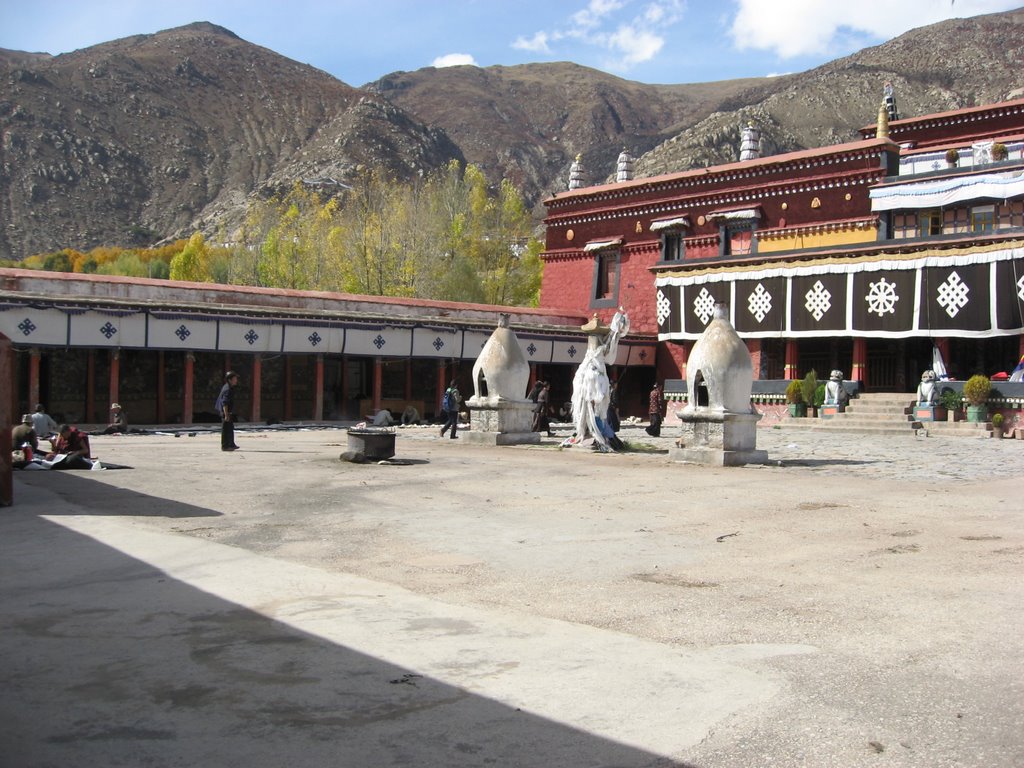

A view of the main courtyard. And a nice self portrait with the monastery in the background.


Nechung Monastery- terrifying temple art


Nechung was the home to the State Oracle back in the day. On New Years Day and whenever the Dalai Lama had a heavy decision to make, he would consult the Oracle of Nechung. The Oracle would dress himself in a mask so large and heavy that it took two people to set it on his head. Then, with intense drumming and cymbal bashing and chanting filling the room he would go into a trance. A CRAZY trance where his eyes would reportedly swell and roll back in his head and he spasmed and lurched around the room. He would then begin to speak in a voice from another realm, the voice of the protector deity of Nechung, which he was now channeling. The deity would give it's advice or predictions and then depart the Oracle's body, leaving him faint and barely able to move. The deity has quite a dark and deeply mysterious aspect, and because this is his temple much of the art here is a bit gruesome and horrific. Also this is a tantric temple and I will not even pretend that I know what this means, but all the tantric temples I visited had alot of skulls and flayed human skins in their symbology...
at Nechung Monastery

Looking up the crack where we started our hike later. Noticing all the prayer flags is what originally led to the idea of climbing to the peak using them as a guide. I mean, someone had to climb up there to hang those flags, right? There MUST be a trail leading to and through them, right? And from there it's just a quick climb to the top...right? The starkness of the landscape here in Tibet can be quite deceptive, especially when it comes to distances and heights of mountains, I learned.

on a ridge over Nechung...

Climbed to the peak of a finger coming off the main ridge over the Nechung Monastery. Stopped for a brief rest on the side of this giant incense burner. We kept going up... our destination being the peak of the main ridge!

Saturday, January 06, 2007
Fish over Nechung


A nice shot of Drepung Monastery in the background. And, of course, Fish with the omnipresent prayer flags. On this day, as we had done several times before, we actually used the prayer flags as a guide to show us the best route up the ridge. Where there is no trail, trust the prayer flags. And if all else fails scrabble up the ridge on all fours. I did.
Hike over Nechung Monastery


After visiting Nechung, we decided to go for a hike up the ridge above, and then walk down the spine back to the main road where we would catch our bus. This turned out to be quite a hike, and much more challenging than either of us had expected. We caught some amazing views from way up there though. All of Lhasa valley, a great city view, and also great vistas of Drepung Monastery. We even made it past the stark raving mad ferocious Tibetan mastifs that wanted to eat us on our way down!! Auspicious? Or lucky?
Temple art at the Norbulingka

Painting inside an older temple at the Norbulingka. There was a ferocious wind storm raging though the valley this afternoon, dust and debris whipping through the air, giving our eyes a good sand blasting. We ducked in here for some relief.
The Norbulingka


This was a large park/garden that was the summer residence of all the Dalai Lamas, since his 7th incarnation. The present, 14th incarnation of the Dalai Lama built his residence here only 5 years before he fled Tibet. That is the building you see here. It was a very eery place to visit. The air was thick with emptiness and the space devoid of life. It was expressly forbidden to take photos inside the house, but team holler got a few shots for posterity. Enjoy the private bathroom of the Dalai Lama, as well as your exclusive look at his very bed...
Smoked Out!


Still in front of the Jokhang... There are four huge incense burners placed at the four corners of the Jokhang complex. This is one of the two placed in the front. On certain particularly auspicious mornings people would get these things rollin!! Thousands of people bring juniper boughs and the leaves of a type of local artemesia and literally pack these huge censers with plant matter... and then continue to do so all morning long. This was the smokiest we had seen it in the 7 weeks we spent in Tibet. And still folks were cramming juniper into the opening with no signs of slowing down! It was awesome to behold and not just a little difficult to breathe. But the smell is something I will never forget... literally permeated to the core...
Prostraters in front of the Jokhang

The Jokhang is considered the holiest temple in Tibet... often referred to as the spiritual heart of the culture. Because of this, from sunrise until well after dark the square before the temple is filled with pilgrims who have come from all over the country to prostrate and pray here. The mood is very sincere and holy, but there is no shortage of smiles and fun amongst Tibetan people!
Spinning the Wheels...


Every chance I got to spin a prayer wheel I was happy to take! If you are reading this, know that many wheels were spun in your honor! Hundreds in one session often-times! Lots of love keeps these wheels spinning...lots of love, and a WHOLE lotta yak grease that is...
Subscribe to:
Posts (Atom)